Thursday, September 29, 2016

Margaret Sanger, flawed hero
Sanger's first publication was called
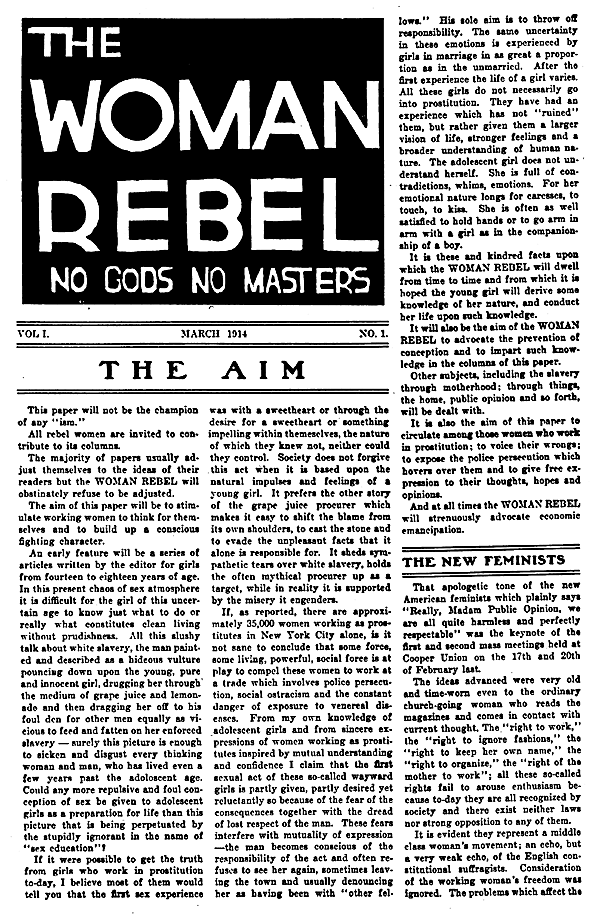 Woman Rebel. Her later, less "red and flaming" publication was called Birth Control Review, shown here and here. She is proof that heroes, including heroes of indy media, are often flawed. This article from Women's E-News discusses her flirtation with eugenics-oriented arguments in support of birth control in the early 1920s.


Tuesday, September 27, 2016
Dinner with Amy
In the early 1900s, the socialist Appeal to Reason newspaper offered yachts, fruit farms and motorcycles as premiums to bring in subscriptions and revenue. Democracy Now! offers "Dinner and a Show with Amy Goodman."
Where are today's Upton Sinclairs?
Colbert accepted the challenge of experiencing difficult working conditions as a farm worker. Here he is doing farm labor (in upstate New York).
Or is it Barbara Ehrenreich, who worked at low wage jobs (waitress, maid, Wal-Mart employee) for her book Nickel and Dimed to see if she could make ends meet?
Or is it Barbara Ehrenreich, who worked at low wage jobs (waitress, maid, Wal-Mart employee) for her book Nickel and Dimed to see if she could make ends meet?

Students continue Ida B. Wells legacy
Over the last 15 years, Northwestern University students (in journalism and law) and their professors were instrumental in proving the innocence of many prisoners in Illinois, several of whom had been sentenced to death. Their investigative journalism was controversial and far from perfect, but it ultimately sparked the abolition of the death penalty in Illinois in 2011.
Lynching prompted the classic Billie Holiday song,"Strange Fruit," which she recorded independently in 1939 -- getting around the objections of Columbia, her record company: "Black bodies swinging in the Southern breeze, strange fruit hanging from the poplar trees." It ultimately became her biggest selling record. Time magazine denounced the song as a "piece of musical propaganda." The song's lyrics were inspired by this photograph of a 1930 lynching in Indiana.

Re Legacy: I'm not aware of any schools named after newspaper editors because they ignored or apologized for racist lynchings. But Ida B. Wells has a high school named after her (school home page here) in San Francisco (just across the park from the famous "painted ladies" Victorian houses.)


Saturday, September 24, 2016
Journalists have to re-fight old battles
Dissident publications throughout history exposed many social wrongs (like the labor weeklies in the 1830s spotlighting the problem of people being jailed simply for being in debt). Exposure led to reform -- debtors' prisons were abolished. But years or generations later, other journalists may have to return to the issue . . . as these investigative journalists for the big mainstream daily in Minneapolis did in 2011.
I.F. Stone pointed out that some reforms don't happen except through the work of generations of journalists and democracy activists:
"It's not a crime to owe money, and debtors' prisons were abolished in the United States in the 19th century. But people are routinely being thrown in jail for failing to pay debts. In Minnesota, which has some of the most creditor-friendly laws in the country, the use of arrest warrants against debtors has jumped 60 percent over the past four years, with 845 cases in 2009, a Star Tribune analysis of state court data has found."The Nation returned to the topic of debtors' prisons in 2014, and Izzy Award-winner John Carlos Frey reported on the same theme for public TV in 2015.
I.F. Stone pointed out that some reforms don't happen except through the work of generations of journalists and democracy activists:
“The only kinds of fights worth fighting are those you are going to lose, because somebody has to fight them and lose and lose and lose until someday, somebody who believes as you do wins. In order for somebody to win an important, major fight 100 years hence, a lot of other people have got to be willing - for the sheer fun and joy of it - to go right ahead and fight, knowing you're going to lose. You mustn't feel like a martyr. You've got to enjoy it.”
Subscribe to:
Posts (Atom)